Saturday, 13 August 2011

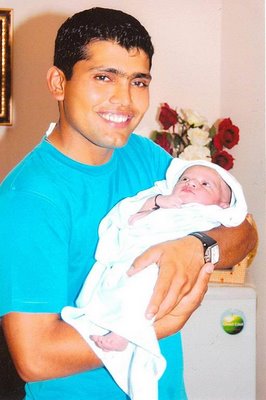
Kamran Akmal

Kamran Akmal Biography
Kamran Akmal (born 13 January 1982 in Lahore) is a Pakistani cricketer who has played 38 Test matches and 88 ODIs for Pakistan. He is a quick-scoring batsman and a wicket-keeper, who has achieved four centuries and two fifties in 31 Test innings. However, his first century was vital - his 109 from the number eight position at Mohali, coming in with Pakistan in a lead of 39 against India in the first Test, ensured that the visitors could draw the match. His form against the touring English in 2005 made him one of the most important players in the team. Naturally, he is a batsman that plays lower down the order but has sometimes opened in both Test and One-day cricket. As an opener he has scored two back to back centuries in ODIs against England. Coming in lower down the order in Test matches, he played one memorable innings. He saved Pakistan from a score of 39/6, scoring a century, to a competitive 245 which helped Pakistan win the match and series. His batting was highly productive in early 2006 as he scored seven international hundreds within the space of 6 months. Since his tour of England in Summer 2006 however his batting form dwindled and steadily become worse. His wicket-keeping also worsened and dropped many catches on both the England tour and on a tour to South Africa in early 2007. Since then he did not score an international hundred until the Bangladeshi tour of Pakistan in 2008. Kamran Akmal was dropped for the Asia Cup 2008 as a result of his poor batting form and very poor keeping. He was replaced by Sarfraz Ahmed who has performed very well the domestic level. Kamran was named in the 30 man probable squad for the 2008 ICC Champions Trophy. On 12 November 2008, Akmal hit two consecutive 6s in the last over. As a result Pakistan won the first ODI in Abu Dhabi against West Indies. Akmal was also signed on to the Rajasthan Royals, and played in the inaugural season of the IPL. He played five matches in the tournament, as wicket-keeper and top-order batsman, including the final of the tournament against the Chennai Super Kings. He took two catches in the first innings, however he was run out for six runs during the Royal's chase. The Royals went on to win the tournament after a thrilling finish.
Kamran Akmal
Kamran Akmal
Kamran Akmal
Kamran Akmal
Kamran Akmal
Kamran Akmal
Kamran Akmal
Kamran Akmal
Kamran akmal great turnaround against west indies
Kamran Akmal 116* v Australia - 5th ODI - Dubai - 2009

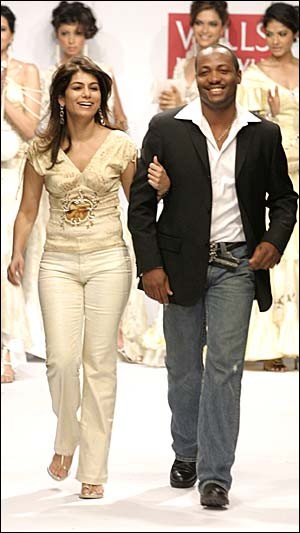
Brian Lara

Brian Lara Biography
Brian Lara is one of the biggest Super stars of the present era .People from all over the world love him because of his extraordinary talent and excessive services for the game of Cricket . People wants to know more and more about Brian Lara . Some very important information about Brian Lara is mentioned below :
PERSONAL INFORMATION
Full Name :
The Full Name Of this legendary Cricketer is Brian Charles Lara . People from all over the world call him Brian Lara .
Date Of Birth :
The Date Of Birth of Brian Lara is 2 nd May , 1969 .
Place Of Birth :
Brian Lara was born at Trinidad West Indies .
Star Sign :
His star sign is Taurus and he is a firm believer on the concept of sun signs .
Profession :
The profession of Brian Lara is that he is a professional Cricketer .
Nick Name :
His nick name or the name given to Brian Lara on his attributes by all his fans and experts is "THE KING OF PORT OF SPAIN " and that reflects the amount of abilities and respect he got in the public .
Batting Style :
He is a prolific Right Handed Batsmen with a wholesome range of shorts .
Bowling Style :
He is a Leg Break Googly Bowler and bowls very rarely in International Cricket .
FAMILY INFORMATION
Father's Name :
The name of his father is Bunty Lara .
Mother's Name :
The name of his mother is Pear Lara .
How Many siblings ?
Brian Lara have 10 siblings including him .
EDUCATION
School's Name :
Brian Lara studied at Fatima College from where he received his Initial education .
College's Name :
Brian Lara's college name was Fatima College from where he received his high school education .
LIKES AND DISLIKES OF BRIAN LARA
Favorite Singer :
Brian Lara's Favorite melody is Alternative ,he is not a music freak and as we all know about the busy schedule of all the Cricketers but in his free time he prefer R&B .
Favorite Movie :
Brian Lara's favorite movie is Mission Impossible 1 , 2 ,3 and Shrek 2
Favorite Color :
His favorite colors are Green , metallic and grey .
Favorite TV Show :
His favorite TV show is F.R.I.E.N.D.S and Sex and the city .
Any Other Favorite Sports :
Football is his most favorite sports after Cricket . Whenever he is free and bored from Cricket , he always prefer Football on any other sports with his mates
Brian Lara 
Brian Lara 
Brian Lara 
Brian Lara 
Brian Lara 
Brian Lara 
Brian Lara 
Brian Lara
Brian Lara's 153
Brian Lara - Batting when he was 15 years Old

Geroge Best

Geroge Best Biography
Footballer, born in Belfast, NE Northern Ireland, UK. He was the leading scorer for Manchester United in the Football League First Division (1967–8), and won a European Cup Medal and the title of European Footballer of the Year (1968). Becoming increasingly unable to cope with the pressure of top-class football, his career was virtually finished by the time he was 25 years old. Attempted come-backs with smaller clubs in England, the USA, and Scotland were unsuccessful.
Geroge Best
Geroge Best
Geroge Best
Geroge Best
Geroge Best
Geroge Best
Geroge Best
Geroge Best
George Best
one of the best by GEORGE BEST

Friday, 12 August 2011

Roger Federer

Roger Federer Biography
Athlete. Born on August 8, 1981, in Basel, Switzerland. His parents, Robert Federer and Lynette Du Rand, met while on a business trip for a pharmaceutical company where they both worked.
Federer took an interest in sports at an early age, playing tennis and soccer at the age of 8. The young athlete excelled at athletics, and by the age of 11 he was among the top 3 junior tennis players in Switzerland. At the age of 12, he decided to quit other sports and focus all his efforts on tennis, which he felt he excelled at more naturally. By the age of 14, he was fully immersed in the game, playing 2-3 tournaments per month, and practicing 6 hours of the game a week along with up to 3 hours of conditioning. To perfect his technique, he often imitated his idols, Boris Becker and Stefan Edberg.
At 14, he became the national junior champion in Switzerland, and was chosen to train at the Swiss National Tennis Center in Ecublens, and had his his first sponsorship by the age of 16. He joined the International Tennis Federation junior tennis circuit in July 1996. In 1998, shortly before he turned pro Federer won the junior Wimbledon title and the Orange Bowl. He was recognized as the ITF World Junior Tennis champion of the year.
In 1998, he won the Wimbledon boys' singles and doubles titles in 1998 and turned professional later that year. At Wimbledon 2001 he caused a sensation by knocking out reigning singles champion Pete Sampras in the fourth round. In 2003, following a successful season on grass, Federer became the first Swiss man to win a Grand Slam title when he became Wimbledon singles champion.
At the beginning of 2004, Federer had a world ranking of number 2, and during that year won the Australian Open, the U.S. Open, the ATP Masters, and retained the Wimbledon singles title. He was ranked number 1 at the start of 2005 and his successes that year include the Wimbledon singles title for a third successive year, and the U.S. Open.
Federer held on to his number 1 ranking at the start of 2006, winning the Australian Open, his fourth successive Wimbledon singles title, and his third successive U.S. Open. Continuing to dominate the sport, the right-handed champion won the singles title at Wimbledon and the U.S. Open again as well as the Australian Open in 2007. Currently ranked No. 1 on the ATP Tour, Federer has been named Laureus World Sportsman of the Year Award three times—in 2005, 2006, and 2007.
Federer was in the finals for a sixth U.S. Open win, and with the option of victory came the possibility of breaking several records. Federer lost, however, to Juan Martin del Potro.
When he's not on tour, Federer lives in Oberwil, Switzerland. Outside of tennis, he established the Roger Federer Foundation to support projects that help children learn worldwide and that promote sports in his native Switzerland.
Roger Federer
Roger Federer
Roger Federer
Roger Federer
Roger Federer
Roger Federer
Roger Federer
Roger Federer
Roger Federer - Stunning Game!
Roger Federer - Beautiful Motion (HD)

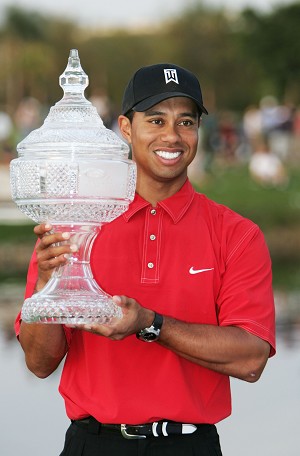
Tiger Woods

Tiger Woods Biography
Born Eldrick T. Woods on December 30, 1975, in Cypress, Calif., golf phenom Tiger Woods has had a career nothing short of spectacular. His father, Earl Woods, began teaching his son the game when he was just a year old. In fact, Tiger's skills were so good at such a young age that it landed him an appearance on the Mike Douglas Show in 1978. The two-year-old Woods' appearance put him up against legendary comedian Bob Hope in a putting contest. At three, he shot a 48 over nine holes at one of his hometown courses. When Tiger was five he appeared on television's "That's Incredible" and in Golf Digest magazine.
After winning six junior championships between the ages of eight and 15, Tiger went on to become the youngest U.S. Junior Amateur Champion in history, a feat he would repeat the following year, making him also the only player to ever win more than once. He would even go on to win it for a third consecutive time the following year. At 16 he competed in the Nissan Los Angeles Open, his first PGA Tour event. At 18, Woods won the U.S. Amateur Championship, the youngest to accomplish this feat. Next, he enrolled at Stanford University and at 19 successfully defended his Amateur Championship title, the second of three consecutive titles.
In August 1996 Tiger turned pro and immediately was approached by Nike and Titleist to sign endorsement deals worth a total of $60 million. On the golf course he nearly earned his first million through his play in just eight events. Subsequently he was named Sportsman of the Year by Sports Illustrated magazine. In 1997, at age 21, Tiger became the youngest winner of The Masters tournament, his first major win, setting a record for the largest margin of victory ever at the event (an astounding 12 strokes). He also led the tour in earnings with a record $2.06 million; and in just his 42nd week as a pro Woods had claimed the number-one spot in the world golf rankings.
1998 would prove to be a bit of a slump for Tiger. While focusing more on improving his swing than winning, due to his changing body, he only won one event and dipped to fourth overall on the money list. This was somewhat a good thing, because at the onset of his career there was criticism and speculation about the possibility that Tiger was so good that he would ultimately be bad for the game. His early run of domination led some to believe that the sport would become less competitive as it seemed no one could catch him or compete evenly with him. But in 1999, Tiger bounced back and began a period of sheer dominance over every other golfer. He entered 21 events and won eight (including the final four events of the year), finishing in the top ten 16 times. He shattered the previous mark for yearly earnings with $6.6 million. Tiger began 2000 in true form, winning the first two events to increase his consecutive win streak to six, the longest such streak since 1948 when Ben Hogan accomplished the feat. Next, he went on to win the U.S. Open by the largest margin of strokes in a major at 15; and after four years as a pro he became the all-time tour money winner. He finished the year winning three consecutive majors after a fifth-place finish at The Masters, becoming only the second player in history (after Ben Hogan) to win three in a single season.
Tiger began the 2001 season by winning The Masters to become the reigning champ in all four majors concurrently and the first player to win each major consecutively, though not in the same season. In 2002, he won his third Masters and his second U.S. Open, the sixth and seventh of his 11 career majors. But Tiger's game declined over the next few years, and speculation arose that he was indeed human after all. In 2003 he won five of the 18 tournaments he participated in, but none of those were in any of the majors. In 2004, after a record 264 weeks at the top, Tiger lost the number-one ranking to Fijian Vijay Singh. However, that same year he passed the career earnings mark of $40 million, the first player ever to do so.
Early in 2005, Tiger won the Buick Invitational, putting him on the fast track back to possible golf dominance. Next, he defeated Chris DiMarco on a playoff hole to win The Masters for the fourth time, joining Jack Nicklaus and Arnold Palmer as the only other golfer to win the event four or more times. Tiger also won his second British Open, which put him in the company of Jack Nicklaus as the only two golfers to win each major twice. In April, he regained his number-one ranking from Singh, and the two flip-flopped first and second for a couple months before Tiger began breaking away.
So far, during two periods of his career he has slumped, citing focus on honing his swing each time, after which he successfully rebounded. But interest in the game has remained, and since Tiger began professional play televised golf ratings have steadily raised and currently top baseball and basketball. However, viewership skyrockets when Tiger is playing well or leading. In turn, despite the negative press at the beginning of his career, Tiger has almost single-handedly revolutionized the game, spawning a huge boom of interest in the sport by casual viewers.
Throughout the course of his illustrious career, Tiger has won 10 Majors, 46 PGA Tournaments, and a combined 36 wins between the Asian Tour, PGA European Tour, World Cup of Golf, and several other unofficial events. He's established several charity organizations, including the Tiger Woods Foundation, a charity that benefits children, which he created with his father.
Tiger Woods
Tiger Woods
Tiger Woods
Tiger Woods
Tiger Woods
Tiger Woods
Tiger Woods
Tiger Woods
Tiger Woods Shoots Worst Score Ever at PGA
Tiger woods PGA championship 2010

James Anderson

James Anderson Biography
Major teams England
Nickname Jimmy
Playing role Bowler
Batting style Left-hand bat
Bowling style Right-arm fast-medium
Height 6 ft 2 in
Education St Theodore's RC High School; St Theodore's RC Sixth Form Centre - Burnley
Blessed with raw pace following a growth spurt in his teens, James Anderson was pushed to the England fold without a single county appearance, based purely on his performances for Burnley Cricket Club. As with contemporaries like Shoaib Akhtar and Brett Lee, his speed was enough to unsettle the very best.
An early ODI debut against Australia was handed on the back of a mere five List A matches. It ended with a hammering, as he returned with figures of 1/46 off 6. Anderson later went on to represent Lancashire, being a prolific county wicket-taker. Selected for the 2003 World Cup, impressive spells against Pakistan were tarred by a disastrous last over against Australia which knocked England out. He later made his test debut, recording five scalps against Zimbabwe at Lord’s. Often, the physical demands of pace bowling took a toll on Anderson, resulting in various injuries.
All through his budding years, under coaches Duncan Fletcher and Peter Moores, Anderson’s form remained inconsistent. While an ODI regular ever since his debut, his erratic Test form saw him repeatedly dropped in favour of Simon Jones, Liam Plunkett and Stuart Broad. Poor outings at South Africa (2005) and Australia (2006) and were nullified by impressive displays against India (in England, 2007) and on tour to New Zealand (2008). Bowling blitzkriegs on regular occasions meant he did record five-fors against most test oppositions.
Finally, it was only under Andy Flower’s guidance that England’s golden boy Anderson came of age, recording his 100th Test and ODI wickets against India and South Africa in 2008 and 2009 respectively. Later in 2009, he featured in all five Ashes tests resulting in England’s retention. By 2010, Jimmy Anderson had become a regular for England, taking wickets in bulk, in Tests against South Africa and Pakistan.
Fast Facts
* In 2003 at the Oval, Anderson set the record as the youngest Englishman ever to take a hat-trick.
* He also became England's first player and the 15th in the world to record an ODI hat-trick.
* He is only the 17th Englishman to collect five wickets in an innings on debut.
* Anderson's is England's second-highest wicket-taker in ODI's, behind Darren Gough.
* He is the first Englishman to dismiss India's golden trio of Rahul Dravid, Sachin Tendulkar, and Sourav Ganguly in the same innings.
* Jimmy Anderson is among the top-5 leading wicket-takers for England in all formats put together.
* His haul of 5/23 against South Africa is England's 8th best performance in ODIs.
* With 10 five-wicket hauls to his name in Tests, he stands 10th among England's five-wicket haul specialists.
* His disastrous 1/86 at the end of 10 overs in an ODI at Napier against New Zealand is the second most expensive for an Englishman.
James Anderson Batting, Fielding and Bowling
The above stats are as per date of this post.
James Anderson Career
Test:
2003-2011
ODI:
2002-2010
T20:
2007-2009
James Anderson Test Matches
Debut:
England Vs Zimbabwe at Lord's, London - May 22, 2003
Last played:
England Vs Australia at Sydney Cricket Ground (SCG), Sydney - Jan 03, 2011
James Anderson ODI Matches
Debut:
England Vs Australia at Melbourne Cricket Ground (MCG), Melbourne - Victoria - Dec 15, 2002
Last played:
England Vs Pakistan at The Rose Bowl, Southampton - Sep 22, 2010
James Anderson T20 Matches
Debut:
England Vs Australia at Sydney Cricket Ground (SCG), Sydney - Jan 09, 2007
Last played:
England Vs South Africa at SuperSport Park, Centurion - Nov 15, 2009
Best Wishes To James Anderson for the ICC Cricket World Cup 2011

James Anderson
James Anderson
James Anderson
James Anderson
James Anderson
James Anderson
James Anderson
James Anderson
Ashes winners - Exclusive interview with James Anderson
Ashes Winners - Exclusive interview with Matt Prior

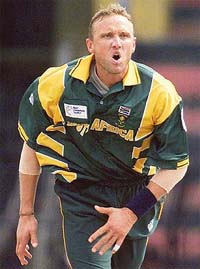
Allan Donald

Allan Donald Biography
Allan Anthony Donald, (born 20 October 1966 in Bloemfontein) is a former South African cricketer, and one of their most successful pace bowlers ever. In his prime, he was one of the best fast bowlers ever seen in Test cricket, reaching the top of the ICC Test rankings in 1998, and peaked with a top ICC ranking of 895 points the next year, the 25th best ranking ever. In ODIs, he reached 794 points in 1998, second place to his teammate Shaun Pollock, the 28th best ranking ever. In the early 1990s, he was arguably the only world-class bowler in the South African team, until the emergence of Pollock, with whom he made a healthy new-ball partnership from the 1996/1997 tour of India until his retirement in 2002. A graph showing Donald's test career bowling statistics and how they have varied over time. He made his Test debut on 18 April 1992 in South Africa's first test since their return to world sport after the abolition of apartheid. South Africa lost to the West Indies in Barbados by 52 runs, but Donald took 2-67 and 4-77, including the prized wicket of Brian Lara. Known as 'White Lightning', he is remembered as a fearsome fast bowler, scowling and aggressive, with a circular white area of zinc cream across his cheeks and nose. When he retired, he was South Africa's record wicket-taker with 330 Test wickets at an average of 22.25, and claimed 272 One Day International wickets at an average of 21.78. Both of these records have now been overtaken by Shaun Pollock.
Allan Donald 
Allan Donald 
Allan Donald 
Allan Donald 
Allan Donald 
Allan Donald 
Allan Donald 
Allan Donald
Allan Donald hostile spell to the Waugh brothers, 2nd test SCG 1997/98
Allan Donald 6/59 vs Australia 1st test MCG 1997/98